Enriched by the teachings of professors I met during residencies in India, Cuba and Senegal (Pandit Shankar Ghosh in Calcutta, Milian Gali Rivieri in Santiago de Cuba…) I now offer, on demand, individual and group lessons in rhythm, instrumental and body percussion.
Percussions
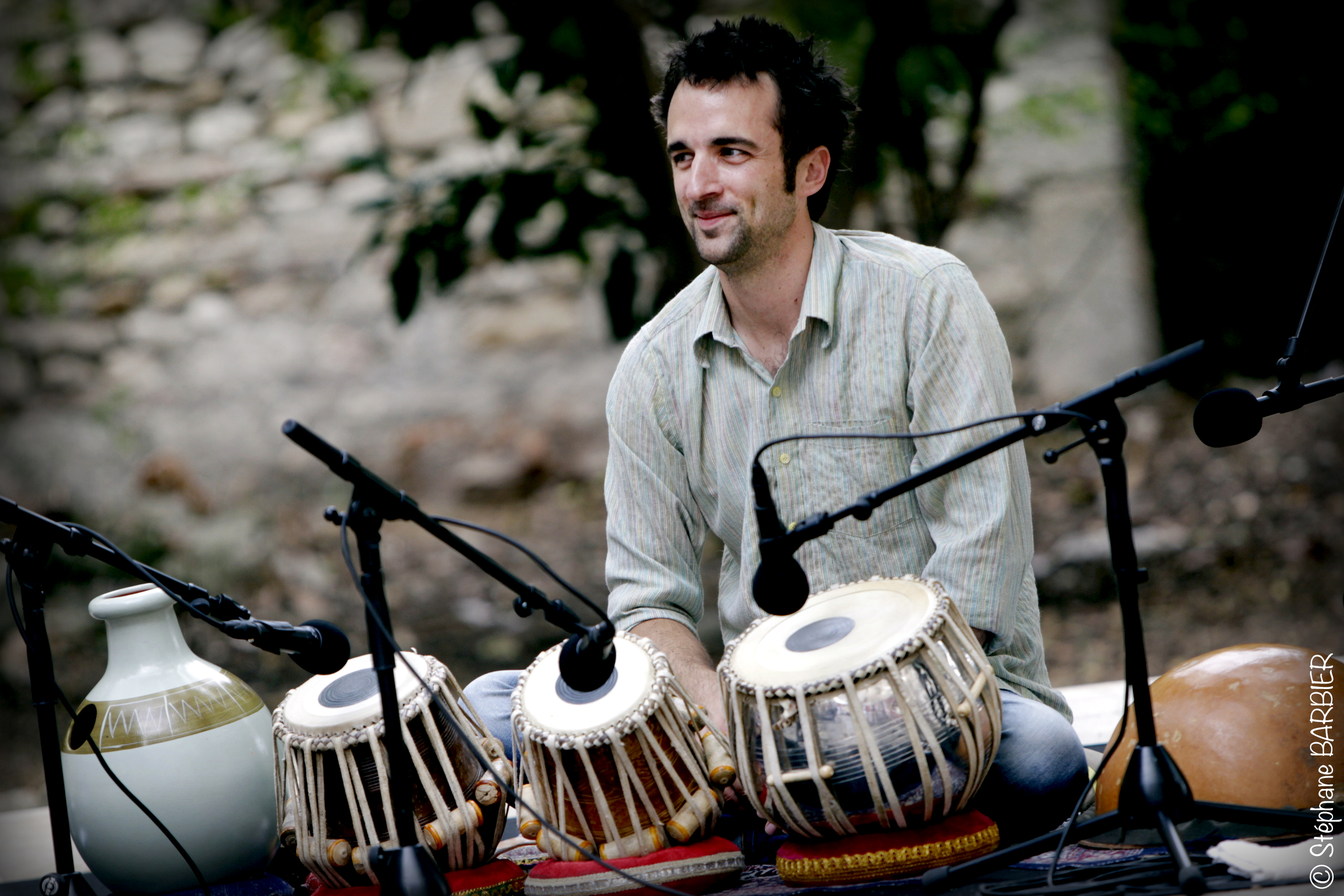
Tablas, congas, cajon, small percussion (caxixi, kass kass, guiro…) Indian, Afro-Latin, rumba rhythms…
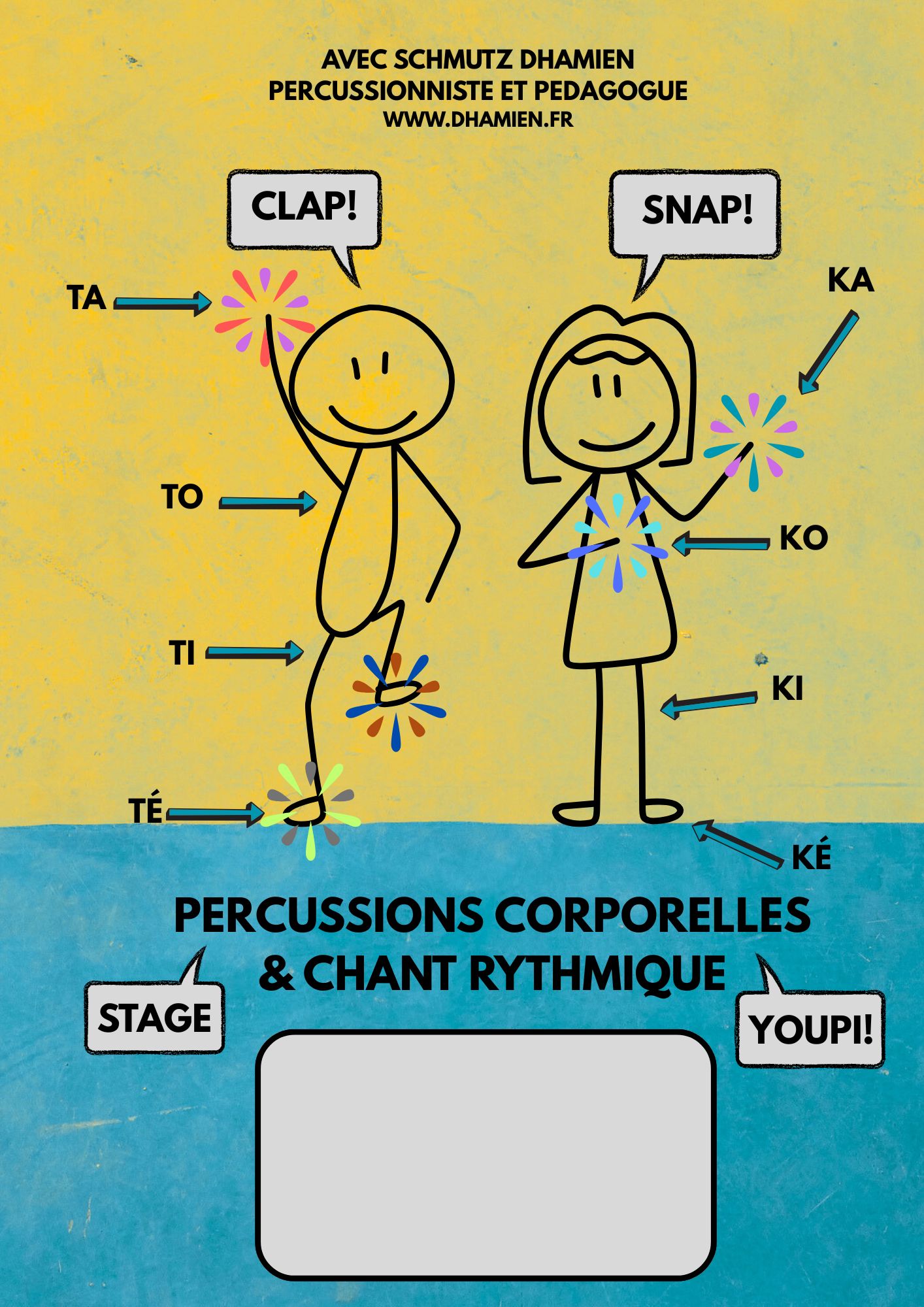
Body Percussion
Body percussion allows a global discovery of the world's music (Brazil, Africa, the Orient…), musical styles (funk, Hip Hop, rock…) and the resonances of our body in collective compositions. Requiring neither advanced technique nor any special equipment, it is naturally accessible to everyone.
Konnakol
Konnakol is a phonetic rhythmic system from South India. It consists of combinations of sung onomatopoeia accompanied by hand claps marking a rhythmic cycle. It is taught in India to percussionists, melodists and dancers alike. The various games and exercises offered bring a genuine rhythmic liberation.
Download the brochure
Beatbox
Literally a « rhythm box », imitation of percussion through the accentuation of consonants in specific onomatopoeia (bass drums, snare drums, hi-hats…). A technique that allows singing multiple parts simultaneously.
Batucada
Batucada, of Brazilian origin, is a set of instruments forming a percussion battery. Several families of percussion combining surdos (bass drums), caixa (snare drums), Agogo (double-toned bells), tamborin, ganza (shaker) … allow the orchestra to move while playing traditional (samba, Baiao, maracatu …) and modern (funk, samba reggae) polyrhythms led by a conductor.
Soundpainting / Circle Songs
Soundpainting is a multidisciplinary real-time artistic creation sign language developed by Walter Thompson in the 1970s. It is intended for musicians, dancers, actors and visual artists. Constantly evolving, this language has more than 1,200 hand and body signs designating different types of artistic materials…
I became particularly interested in the proposal of Argentine percussionist Santiago Vasquez, who offers signs specifically for percussion orchestras.
The Circle Song is a simple and ancient group singing principle in which singers arranged in a circle « rotate » a basic sung pattern, inspired by African, Latin, groove, traditional folk or jazz influences. The Circle Song offers singers a privileged context for listening, sharing, and exploring vocal improvisation. There are different ways to orchestrate Circle Songs, from arrangements imposed by the conductor to total improvisation with or without several leaders. These workshops explore traditional songs of various origins in polyphony, following the oral tradition (no sheet music).